A buddy of mine in Carmel called me last winter, and you could hear the frustration in his voice. “Every morning, my shower feels like a drizzle, and the water looks like iced tea,” he said. His house—a classic 1960s ranch—still had the original galvanized pipes. A new pinhole leak popped up every few months, and he was sick of patching drywall and paying for quick fixes. That’s when we started talking about a whole-house repipe. He had the same questions everybody does: How much? How long? Is my house going to be a disaster zone? If you’re in an older Indy-area home, you’ve probably wondered the same. Let’s walk through what we’ve learned from dozens of repipes in neighborhoods from Meridian-Kessler to downtown Noblesville—what it really costs, how we keep the mess minimal, and what you can expect day to day.
When Should You Think About a Whole-House Repipe?
Spot repairs are like playing whack-a-mole—you fix one leak, and another pops up six feet away. If your home still has galvanized steel pipes (common in mid-century builds around Broad Ripple or Irvington), those pipes are living on borrowed time. They rust from the inside out, narrowing the opening until your upstairs shower barely trickles. Other signs: rusty or metallic-tasting water, low pressure that doesn’t improve after cleaning aerators, or pinhole leaks in copper pipes (yes, even copper can fail, especially with Indy’s hard water). A full repipe replaces everything—from the water main connection inside the house to every fixture and appliance—with fresh, modern lines.
The Real Cost of Whole-House Repiping in Indianapolis
Nobody likes sticker shock, so let’s get into the numbers. Ballpark, the whole house repiping cost Indianapolis homeowners see runs about $5,500 to $18,000. That range covers everything from a small 1-bath ranch on a basement (easy access, less pipe) up to a 3–4 bath two-story with finished ceilings and a slab section. Most of the difference comes down to four things: how many fixtures, what the pipe runs through, what material you pick, and how much drywall we have to open.
A 2-bath 1,200-square-foot ranch with an unfinished basement in Greenwood? You’re probably in the $6,500–$8,500 zone using PEX. Same house but with Type L copper? Toss in 40–60% more—maybe $10,000–$13,000. A bigger 3-bath two-story in Fishers with bathrooms stacked over the kitchen and a finished basement? That can push $12,000–$18,000 with PEX, and $17,000–$25,000 with copper. Slab-on-grade sections—common in some Avon and Plainfield additions—add cost because we have to reroute lines through walls or soffits instead of dropping straight down. No matter the number, you’ll get a written, line-by-line estimate so you know exactly where every dollar goes.
PEX vs. Copper: What Works Here
Most Indy repipes today use PEX-A with expansion fittings. It’s quieter, handles freeze-thaw swings better in unconditioned crawlspaces or basements, and doesn’t scale up the way copper can with our hard water. Copper’s been the gold standard forever, and it’ll outlast us all if the water chemistry is kind—but it costs twice as much to install and can spring pinhole leaks in homes with aggressive water. If you’re on a well (lots of folks in Zionsville and Westfield are), acid water can chew through copper in a decade. We always nudge well owners to check out our well water testing guide before picking a pipe material.
How Long Does It Take, and Will I Be Without Water?
Most 2-bath ranches wrap up in 2–3 working days. A larger two-story or slab job stretches to 4–6 days. The key: we rarely shut off water for more than 8 hours a day. Before we start, we map every cold and hot run, isolate zones with valves, and work section by section. So if we’re redoing the bathrooms upstairs, the kitchen sink downstairs usually stays live until lunch. That means your family can function—uncomfortably, sure, but you’re not moving into a hotel.
Daily Cleanup and Drywall Repair
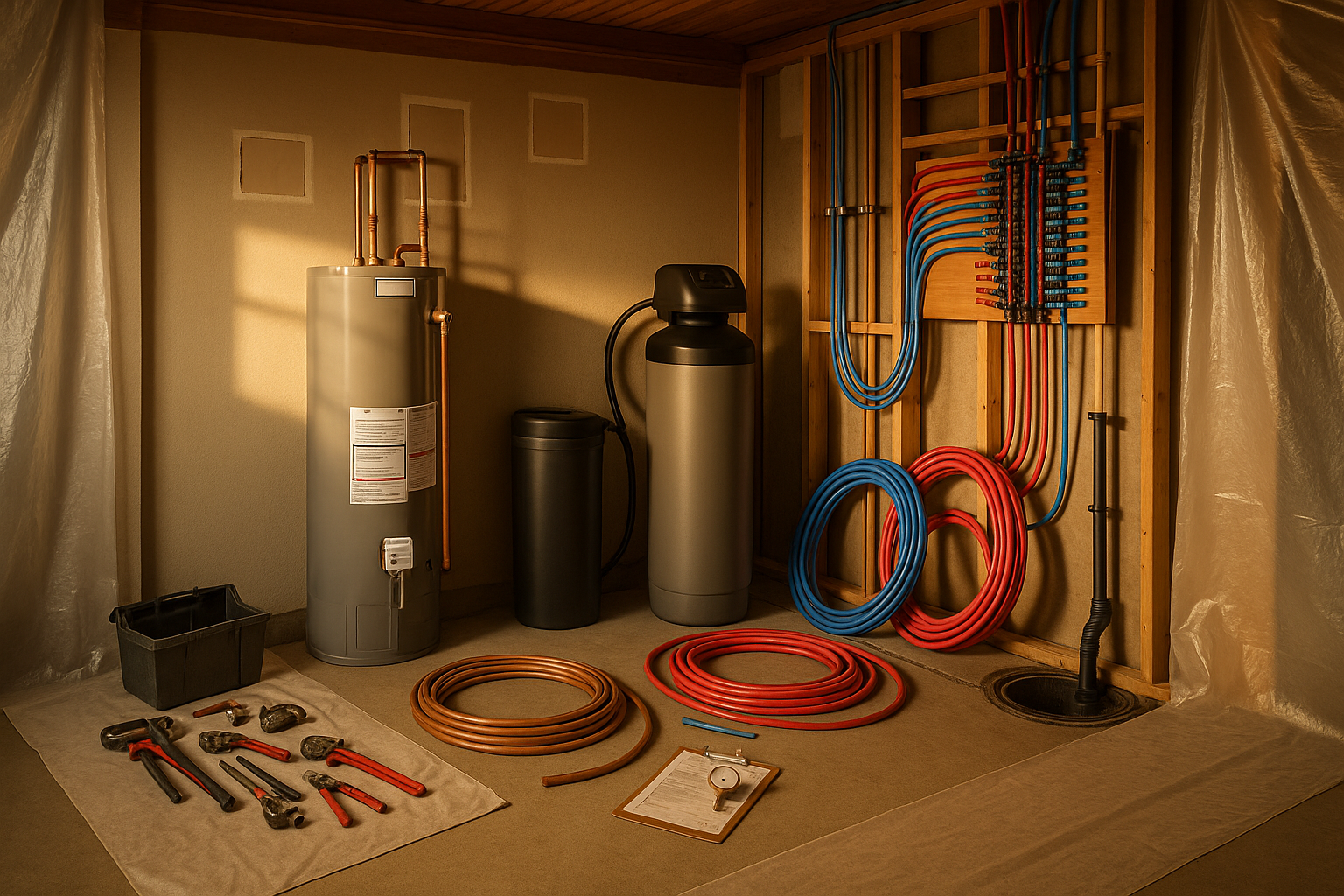
We cut access openings only where necessary—typically a few rectangles in closets or behind vanities—and we hang heavy plastic and runners to contain dust. Every evening, the crew sweeps, vacuums, and wipes down surfaces. Drywall patches are textured to match and left paint-ready. If you want us to handle painting too, we can arrange that, but most homeowners use their own painter for a perfect color match. No jagged holes left for you to stare at.
What Else Goes Into the Price? Permits, Inspections, and the Surprises
Permits are required in Indianapolis and all the surrounding cities. We pull them ourselves, coordinate with the local inspection office, and stand with you while the inspector checks pressure tests, pipe supports, and tie-ins. That usually adds a day to the schedule, but it’s non-negotiable for a safe, insurable job. Sometimes the inspector calls out an unrelated code issue—an outdoor hose bib that’s not frost-free, for instance—and we’ll offer to fix it while the wall is already open. Expect a $200–$500 line item for permits, depending on the municipality.
Bad Surprises and How We Handle Them
Opening walls sometimes reveals rotted subfloor from an old leak, or termite damage, or electrical work that needs a pro. We won’t hide it. You’ll get photos, a clear explanation, and a fixed price to remedy it. No upsells, no “while you’re at it” unless it’s a genuine safety issue. Most of the time, though, it’s just dusty old pipe.
We’re Not Just Pipe Swappers—Other Systems Benefit Too
Repiping is the perfect time to address hard water for good. Since WaterPros also handles water softening and filtration, we can stub in a softener loop or install a whole-house system while the ceiling is open. That way you’re not paying twice for wall repairs later. Peek at our whole-house water filtration page to see what combos make sense for your water.
If your home is on a septic system (looking at you, Brownsburg and Avon), we’re extra careful about not dumping a ton of water into the drain field all at once during flushing and testing. And if your drains have been slow for a while, it might not be the pipes—it could be a tired drain field. Before you blame the supply lines, read our drainfield failure signs guide to rule that out.
While we’re in the basement or crawlspace, we check your sump pump and drainage, too. Lots of Indy homes rely on them, and a repipe is a rotten time to discover your backup battery is dead. A few minutes of inspecting the pit and discharge line can save a flood later. If you’re already nervous about basement water, our sump pump battery backup rundown explains cheap fixes that keep you dry.
Keeping the Budget Manageable Without Cutting Corners
- Choose PEX. Unless you have a specific reason to run copper (like a condo association rule), PEX-A gives you decades of service for much less money.
- Group fixture runs. Stacking bathrooms? Keeping runs short saves material and labor. Our manifold design in basements cuts the number of in-wall joints.
- Bundle projects. Need a water heater replaced soon? Do it during the repipe—the wall is already open, so you dodge drywall work twice.
- Phase the work. If the upstairs and downstairs pipes are totally separate, you could do one level this year and the other next. It’s not ideal, but it spreads the hit.
Financing is available through partners we trust. No pushy lenders, just straightforward paperwork that lets you bite off the project now and pay over time.
Quick Answers to Stuff You’re Probably Wondering
Do I really need a permit?
Yep, in Indianapolis and every suburb we serve. Skipping it can bite you when you sell the house or file an insurance claim. We handle the whole thing.
How do you not wreck my walls?
We use a small drywall saw, cut clean rectangles, and patch them with fiberglass tape and setting compound. They’ll be paint-ready, and we can match texture from a photo of your wall. Most people repaint the whole room afterward anyway, but you won’t see seams once painted.
What warranty do you offer?
Our workmanship is guaranteed for [X years—check our quote for exact terms], and PEX or copper manufacturers have their own material warranties. We’re not going to ghost you after the check clears.
Will repiping fix my low water pressure?
Almost always yes—if the issue is corroded pipes. If the city supply pressure is low, that’s a different problem, but we measure that first thing so you know what to expect.
Ready to Stop Worrying About Your Pipes?
A whole-house repipe is one of those big, grown-up things you do once and then forget about for decades. If you’re tired of playing leak detective, give us a shout. We’ll come out, crawl through your basement and attic, measure everything, and hand you a detailed, written quote with PEX and copper options. No pressure, no wild estimates over the phone. Hit the quote request form or call us to set up a free in-home assessment. Because the only thing worse than a burst pipe at 2 a.m. is knowing you could have fixed it before it burst.
Need a plumber you can call back?
Licensed Indiana plumbers, flat-rate pricing, and a written warranty on every job.