Last winter my buddy Rachel had her in-laws staying over in Broad Ripple. Morning came, and three showers plus a load of laundry later, the last person got a blast of ice water. Nobody was happy. She called me in a panic: "I just bought this water heater, how can it be too small?" The problem wasn't the heater—it was the sizing. The installer had eyeballed it, and her family's real-world use blew right past what the old tank could recover. So let's answer the question every homeowner eventually asks: what size water heater do i need? Spoiler: it's not just about gallons.
Start With Your Busiest Hour
Forget how many bedrooms you have. The real number comes from what happens during your home's busiest hour—usually morning rush or evening cleanup. Walk through your house and add up every fixture that might be running at once: - Shower: 1.8–2.5 GPM (gallons per minute), about 70% hot water - Bathroom sink: 0.5–1.0 GPM, about 50% hot - Kitchen sink: 1.0–1.5 GPM, about 50% hot - Dishwasher: 1.0–2.0 GPM, often 100% hot - Clothes washer: 2.0–2.5 GPM, varies
A typical family of four in Fishers might have two showers going (say 2.0 GPM each, 70% hot = 2.8 GPM total hot water), plus the dishwasher (1.5 GPM, all hot), and a kitchen sink (0.75 GPM hot). That's over 5 gallons per minute of hot water needed at peak. If your water heater can't keep up, someone's getting a cold surprise.
Tank Water Heaters: Matching the First Hour Rating
For a tank, the key number is the First Hour Rating (FHR)—how many gallons of hot water it can deliver in an hour starting with a full tank. The tank size alone isn't enough; you need to factor in recovery. A 40-gallon gas unit might deliver 60-70 gallons in the first hour because it heats quickly. An electric model of the same size might only do 45-50 gallons.
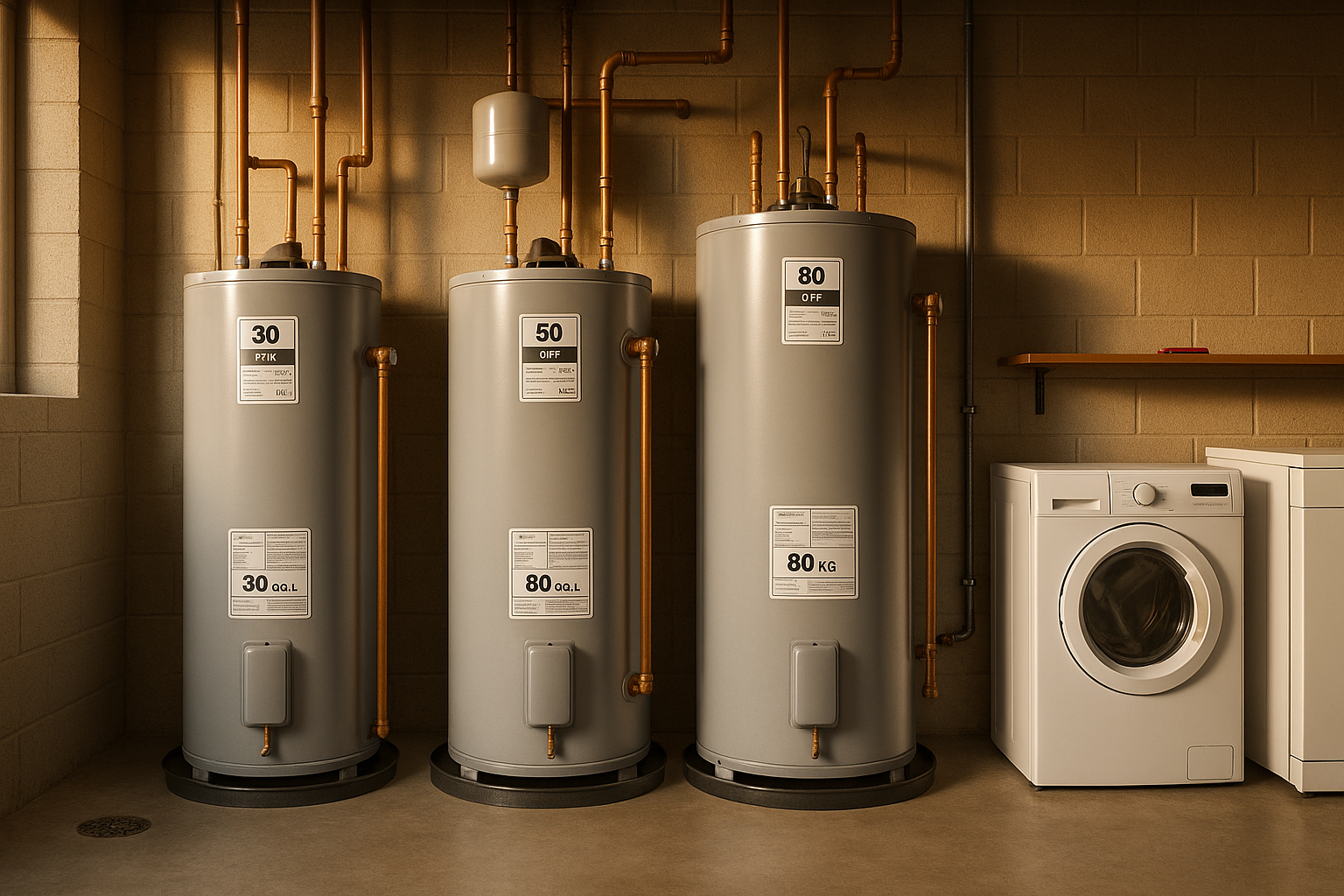
So quick guide: for 1–2 people, 30–40 gallons usually works. For 3–4 people, 50 gallons is the sweet spot—one of my customers in Carmel with two teenagers said their 50-gallon gas heater handles back-to-back showers fine, as long as nobody runs the dishwasher at the same time. Five or more people? Look at 66 or even 80 gallons, especially if you've got a soaking tub. I remember a family in Zionsville who installed a 66-gallon heat pump water heater; they liked the efficiency but had to kick it into high-demand mode when the grandkids visited.
Recovery rates matter big time. Gas models recover about twice as fast as standard electric. So if you're debating a 40-gallon vs 50-gallon water heater, a 40-gallon gas unit might actually outperform a 50-gallon electric. Heat pump water heaters are crazy efficient but recover slower—plan for that by either upping the tank size or using a hybrid model with electric backup.
Tankless Sizing: It’s All About Flow and Temperature Rise
With tankless, you size for maximum gallons per minute (GPM) at the needed temperature rise. Here in Indianapolis, winter inlet water can drop to 40°F. To hit a 120°F shower, the heater has to manage an 80°F rise. That's a tough job. A smaller unit might handle one shower fine in July, but in January you'll need more horsepower.
Let's count: two showers (2.5 GPM total hot), plus a kitchen sink (0.75 GPM). That's 3.25 GPM at an 80° rise. Most mid-range tankless units top out around 5 GPM at that rise, so they'll work. But add a dishwasher and you're pushing 4.5 GPM, which might need a bigger model—often a 180k–199k BTU gas unit. Electric tankless units can struggle with high demand unless you upgrade your panel significantly. A Westfield homeowner I worked with tried to run three showers on a 150k BTU gas tankless and was always disappointed in winter; we swapped in a 199k unit and it solved everything.
When someone tells me "tankless won't work here because the water is too cold," I usually say: it will work if you size it right. You just have to be honest about your peak usage.
The Indy Factor: What Makes Sizing Different Here
Hard Water and Your Heater
Central Indiana has notoriously hard water. That mineral buildup coats heating elements, reduces tank capacity over time, and kills efficiency. I've pulled anode rods out of heaters in Avon that looked like furry baseball bats after just three years. (Check out how hard water damages appliances for more on that.) A quality water softener goes a long way to protect your new investment. WaterPros offers softening equipment that integrates right with your plumbing—no more scale surprises.
Well Water Worries
Lots of homes around Noblesville and Brownsburg run on private wells. If that's you, you've got extra things to think about: iron, sulfur, sediment. Those can foul heat exchangers fast on a tankless unit or corrode a tank. We're a well drilling contractor too, and we've seen how proper filtration ahead of the water heater saves costly repairs. A pre-filter and maybe a UV system are often smart add-ons.
Septic System Sensitivities
If your home uses a septic system (common in Plainfield and rural Greenwood), be mindful of your water heater's impact. A huge tank or endless tankless flow can overload the drain field if you're not careful. We service septic systems as well, and the advice is simple: don't oversize without thinking about the system downstream. Good maintenance keeps everything balanced.
Drainage Details
Where does the relief valve discharge go? What about the condensate from a high-efficiency unit? They need to drain somewhere safe. WaterPros handles drainage service, so we'll make sure your new heater's pan and lines are routed correctly—no puddles on the basement floor or frost heave in winter.
Making It Official: Permits, Expansion Tanks, and Venting
In Marion County, you need a permit to replace a water heater. It's not just bureaucracy—it means a inspector will check your installation for safety. Most homes here also need a thermal expansion tank on a closed system (where a check valve or pressure regulator stops water from pushing back into the city main). Without one, pressure spikes can damage your new heater or cause leaks. That's a quick add-on.
Venting matters too, especially in older homes where an existing chimney might be oversized for a new power-vent or condensing unit. If you're switching from a natural-draft to a power-vent water heater, you'll need a proper sidewall vent. A pre-purchase inspection can flag these issues early—just like the ones we do for older homes around Indy.
Efficiency That Pays Off
Look at the Unified Energy Factor (UEF) when comparing models. Higher is better. A heat pump water heater might have a UEF of 3.5, meaning it's 3.5 times as efficient as a standard electric. The upfront cost is higher, but the monthly savings are real. There may be federal tax credits or utility rebates for qualifying models, so don't leave money on the table. Gas condensing tankless units are also top-notch for efficiency, especially if you already have natural gas.
Let’s Get Your Perfect Fit
You don't need an engineering degree to size a water heater—you just need to know your peak demand and the local quirks. WaterPros can send a technician to your home, measure what's really needed, check your venting and electrical, and give you a clear, no-pressure quote. No upsells, just honest advice based on how your family actually lives. Hit the button below to schedule your in-home sizing assessment. We'll make sure you never have to apologize to your mother-in-law for a cold shower again.
Need a plumber you can call back?
Licensed Indiana plumbers, flat-rate pricing, and a written warranty on every job.