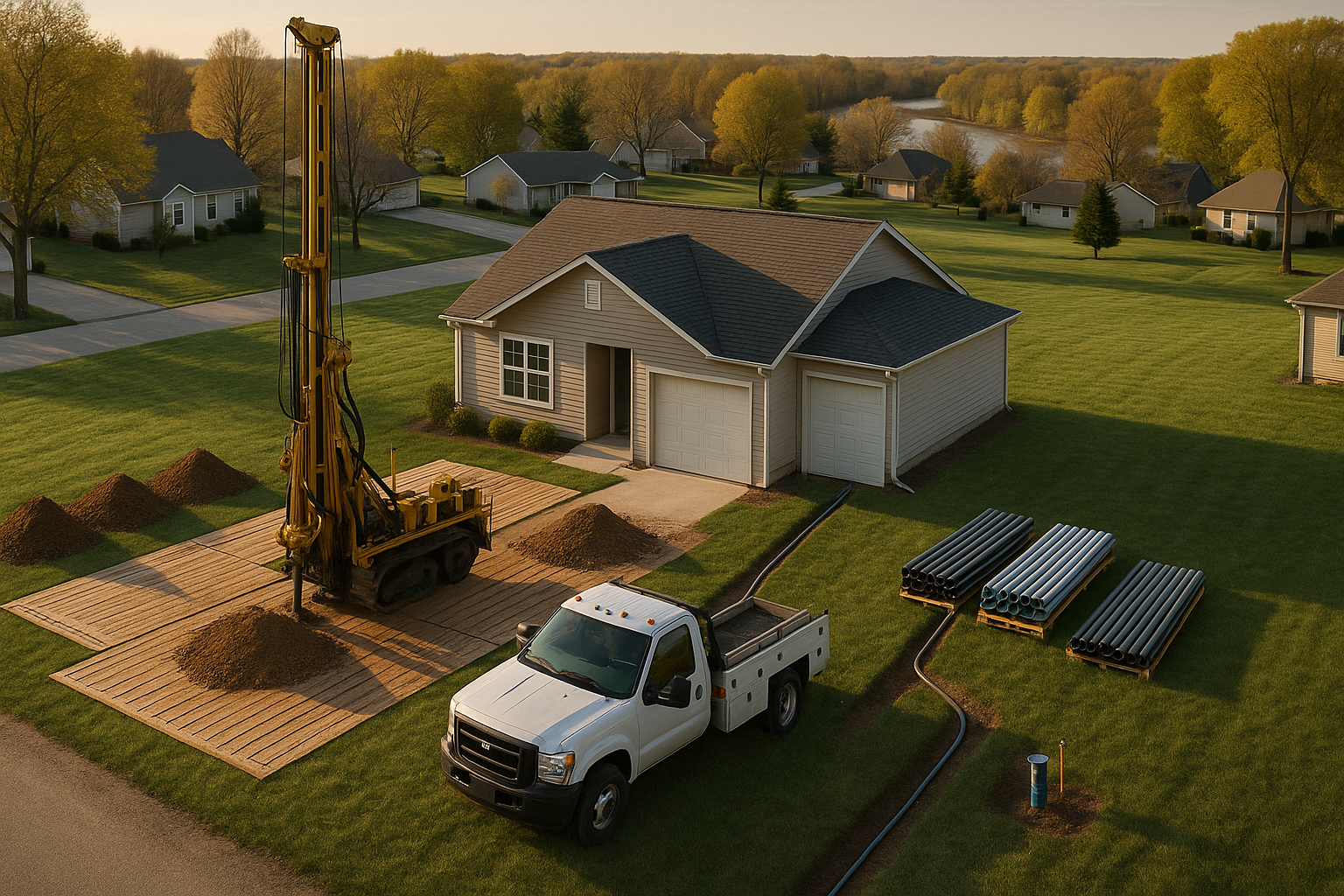
If you’re budgeting a new private well in the Indianapolis area, the most useful number isn’t a single “price per foot”—it’s a realistic, turnkey range for your site. Around Central Indiana, most residential wells complete between roughly $8,000–$20,000+, driven by depth to a reliable aquifer, casing length, local geology, pump and pressure system, trenching, and electrical. Final pricing requires a site review, but this guide explains how well drilling cost in Indianapolis is built—and how WaterPros keeps scope and communication clean from the start.
What drives Indianapolis-area well pricing
Several factors determine the final number on a water well installation. The big drivers are depth and geology, but details in materials and hookups matter, too.
- Depth to usable water: The farther to a consistent aquifer, the higher the footage and casing costs.
- Local geology: Much of Indy sits on glacial till over limestone/shale. Some parcels hit sand/gravel near river valleys; many suburbs require bedrock wells.
- Well diameter: Typical residential wells are 5–6 inches. Diameter influences drilling rate, casing cost, and pump options.
- Casing and grout: Steel or PVC casing through overburden to bedrock; properly grouted annulus is essential for sanitary protection.
- Drilling method and development: Rotary, air, or mud systems; development time to clear fines and improve yield.
- Site access and mobilization: Driveway protection, mats for clay soils, staging area, and spoil management.
- Hookups and electrical: Pump size, drop pipe and wire, pitless adapter, pressure tank, trenching, and power connection.
- Restoration: Backfilling, grading, and lawn/landscape repair as requested.
Typical local cost ranges (line items)
These are common, not universal, ranges we see across Marion and surrounding counties:
- Drilling: $30–$60 per foot depending on diameter, formation, and method
- Steel casing: $20–$40 per foot (length varies until bedrock is sealed)
- Grout/seal: Priced by volume and method; expect a few hundred to over $1,000 depending on annulus
- Permits/records: Indiana DNR filing and county health approvals are additional administrative line items
- Water testing: $100–$300+ depending on panel (bacteria, iron/manganese, hardness, and optional nitrates/metals)
Equipment and hookup components typically added to the above include the submersible pump, power cable, drop pipe, pitless adapter, pressure tank, pressure switch, trenching to the house, and electrical disconnects.
A quick local geology snapshot
- Glacial till over bedrock is standard across Indianapolis and suburbs; depth to bedrock may change within the same road.
- Sand/gravel aquifers are common along the White River and its tributaries; where present, wells may be shallower with strong yields.
- Bedrock in Central Indiana is often Silurian–Devonian limestone or shale. Bedrock wells commonly finish 120–250+ feet.
Equipment, hookups, and the part that’s not “per foot”
A dependable residential system is more than a hole in the ground. The following choices influence performance and cost:
- Submersible pump: Sized to your expected yield and household demand (fixtures, irrigation, and distance to house). Pump model and horsepower drive price. If you’re exploring pump specifics, see our focused page: /well-pump-replacement-indianapolis/.
- Drop pipe and wire: NSF-rated materials sized for depth and flow. Heavier pipe and longer wire add cost as depth increases.
- Pitless adapter and sanitary cap: Code-compliant components for a frost-proof, sealed connection.
- Pressure tank and controls: Correct tank sizing smooths pump cycles and extends equipment life. Oversizing a tank can waste space and budget; undersizing shortens pump life.
- Trenching and electrical: Conduit and water line typically buried 30–36 inches to protect from frost. Longer runs, hard surfaces, and obstacles add time and materials.
- Interior finish: Clean, labeled manifolds and shutoffs in the mechanical room simplify service and upgrades later. Many homeowners pair initial testing with /water-filtration-indianapolis/ options for iron, hardness, or taste.
Permitting, siting, and timeline in Central Indiana
- Indiana DNR compliance: We coordinate state-required well records (well logs) and ensure drilling is performed by a registered contractor.
- County health approvals: Setbacks from septic tanks/fields, property lines, and utilities vary by county—Marion, Hamilton, Hendricks, Boone, Johnson, and Hancock may have nuanced requirements.
- Utility locate (811): Required before any digging. We schedule locates during planning.
- Siting: Plan the rig path, staging space, and spoil placement, especially on tight lots or near new construction.
- Typical timeline: 1–2 weeks for permits and locates, 1–3 days for drilling and system install, 2–5 days for water testing results. Restoration as requested.
Realistic budget examples (estimates)
Use these as planning ranges; site review confirms assumptions.
- Shallow sand/gravel (80–140 ft): $8,000–$12,000. Often near river valleys; shorter casing, moderate pump, moderate trenching.
- Typical bedrock (140–250 ft): $12,000–$18,000. Common in suburbs across Marion, Hamilton, Hendricks, Boone, Johnson, and Hancock counties.
- Deeper/complex (>250 ft or access constraints): $20,000+ due to longer casing, heavier equipment, extended trenching/electrical, or challenging soils.
Local notes by county (trends, not promises):
- Marion County: Depths vary widely; heavy clay can require mats and careful restoration.
- Hamilton County well cost: Many parcels require bedrock wells; some pockets near tributaries may see productive sand/gravel.
- Hendricks and Boone counties: Clay soils and variable bedrock depth; access planning matters on newer subdivisions.
- Johnson and Hancock counties: Similar variability; longer trench runs to the service entrance can impact totals.
Optional or contingent costs to expect
- Hydrofracturing/development: Considered when a bedrock well yields below target; costs vary by depth and method and are only recommended when testing supports it.
- Inline treatment: Softeners, iron filtration, or whole-home filtration are common upgrades after initial water testing. Explore options: /water-filtration-indianapolis/.
- Old well abandonment: Proper decommissioning prevents contamination pathways; pricing depends on depth, construction, and access.
- Driveway/yard protection: Mats or temporary surfaces for soft soils; seasonal conditions can add time and materials.
- Cold-weather measures: Winter-safe curing/sealing or heat if temperatures demand it.
How to compare well drilling quotes fairly
Make sure competing proposals spell out the same assumptions so you’re not comparing a low-scope number to a complete system.
- Target depth allowance and per-foot rates (drill + casing)
- Assumed casing length and diameter; steel vs. PVC where applicable
- Grout method and materials
- Pump model, horsepower, and included accessories (pitless, sanitary cap)
- Drop pipe and wire specs; footage assumptions
- Electrical scope, trenching length, and burial depth
- Water testing panel and who collects/submits samples
- Restoration scope (none/basic/full)
- What logs/records you’ll receive (e.g., DNR well log)
- Warranties and service terms documented by manufacturer and installer responsibilities
If another driller quoted lower, ask what’s excluded. A narrower scope can appear cheaper but lead to add-ons during drilling.
What you can expect with WaterPros
- Planning-first site review: We evaluate access, soil/rock context, trench runs, setbacks, and power—before we price.
- Fixed-scope written proposal: Clear per-foot rates, casing assumptions, and itemized equipment so you know exactly what’s included.
- Right-sized pump and pressure system: Matched to household demand, expected yield, and future plans (irrigation, additions).
- Compliance handled: Indiana DNR coordination, county approvals, 811 locates, and well log submission.
- Clean communication: One point of contact from planning to testing, plus documented results and maintenance guidance. For future pump questions, see /well-pump-replacement-indianapolis/.
Frequently asked questions
How much does it cost to drill a well in Indianapolis and nearby counties?
Most residential projects land between $8,000–$20,000+, with drilling at $30–$60/ft and steel casing at $20–$40/ft, plus grout, pump/equipment, trenching, electrical, permits, and testing. Your final price depends primarily on depth and geology.
What is the average well depth in Marion, Hamilton, Hendricks, Boone, Johnson, and Hancock counties?
Typical finished depths run 120–250+ ft, with shallower cases in sand/gravel near river valleys and deeper bedrock wells common in many suburbs. Depths can vary within short distances.
How is “well cost per foot” calculated and what does it include?
Per-foot pricing usually applies to the drilled footage and the installed casing through overburden. It does not include grout, pump, drop pipe, wire, pitless adapter, pressure tank, trenching, electrical, testing, or restoration—those are itemized separately.
Do I need a permit for a private well, and who files with Indiana DNR?
Yes. Indiana DNR and your county health department have requirements. WaterPros coordinates filings, setbacks, locates, and well log submission as part of our process.
How long does drilling and hookup take?
Permits/locates take about 1–2 weeks. Drilling and system installation are commonly 1–3 days, followed by 2–5 days for initial water test results.
Can you drill in winter in Central Indiana?
Yes, with proper planning. Cold-weather protection, ground conditions, and access may add modest costs or change the schedule.
What distance must my well be from a septic system or property line?
Setbacks vary by county and system type. During planning, we verify your parcel’s requirements and position the well accordingly.
What if the well has low yield—can hydrofracturing help?
Sometimes. For low-yield bedrock wells, hydrofracturing or extended development may improve performance. We only recommend it when data supports the benefit.
How much does it cost to abandon an old well?
Abandonment (decommissioning) varies by construction and depth. Expect a separate line item that includes proper sealing and records to meet Indiana requirements.
What initial water tests are recommended locally?
We commonly test for total coliform/E. coli, hardness, iron/manganese, and often nitrates. Results guide whether treatment is needed; see /water-filtration-indianapolis/ for options.
How often do well pumps need replacement?
Service life depends on usage, water quality, and cycling. When it’s time, our page /well-pump-replacement-indianapolis/ outlines considerations and typical ranges.
Will drilling damage my yard?
We plan rig access, protect surfaces with mats as needed, and define restoration scope in writing. Some disturbance is unavoidable; clear planning minimizes it.
Ready for a clear, local number?
Schedule a site review and receive a fixed-scope, itemized proposal with transparent per-foot and equipment pricing—no surprises, just a dependable plan for your water supply. Use our quick form at /#quote. Get a Free Deck Consultation and we’ll translate your goals, local geology, and access constraints into a practical, premium solution. For more planning tips, visit our /blog/.
Need a plumber you can call back?
Licensed Indiana plumbers, flat-rate pricing, and a written warranty on every job.