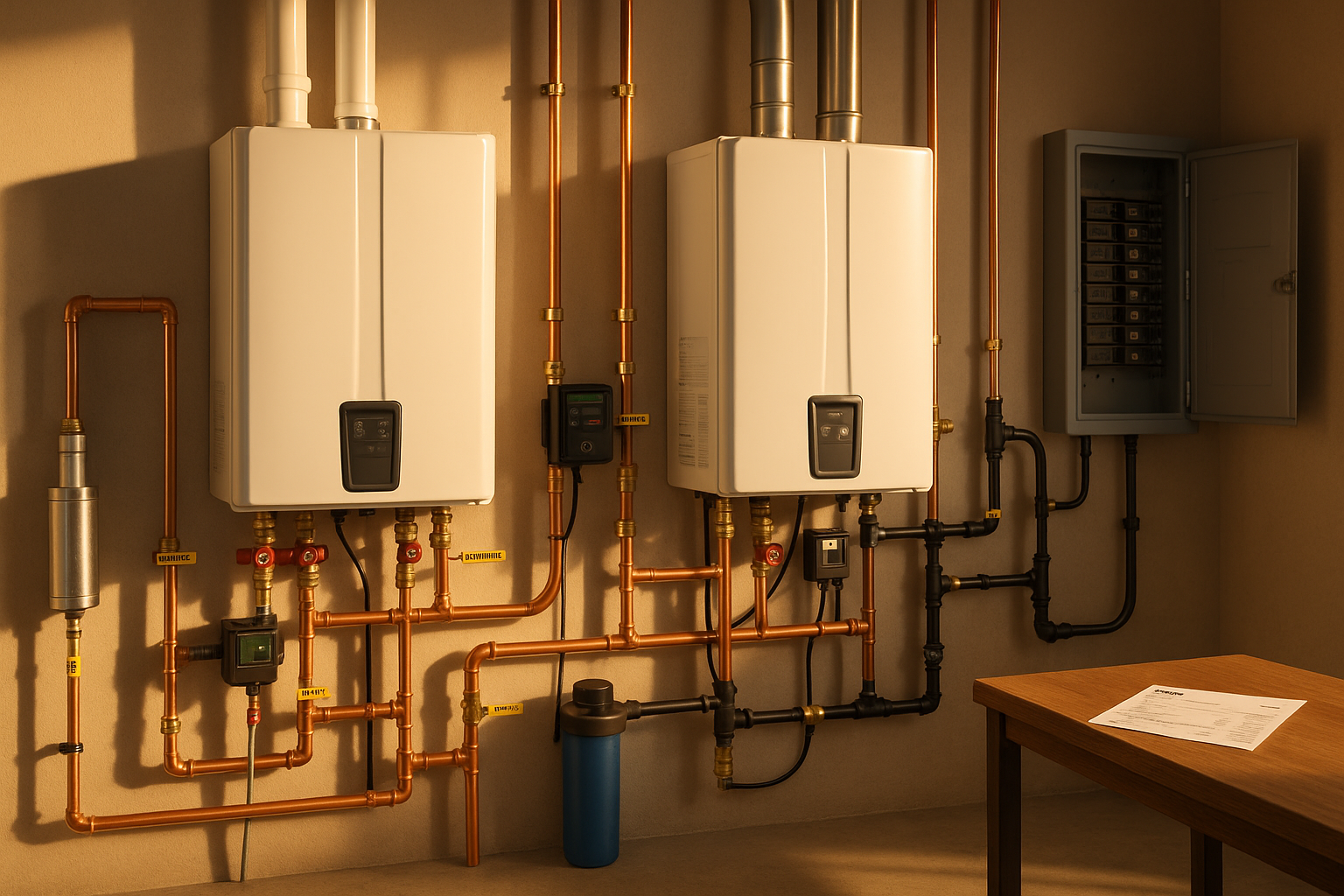
If you’re comparing a high-efficiency tankless to a standard tank, you want straight numbers and a clear scope—not guesswork. This guide explains typical installed pricing for Indianapolis homes, what drives the cost to install a tankless water heater, how we plan for winter performance, and the code and maintenance items to budget so the system runs quietly and reliably for years.
Typical installed pricing in Indianapolis
For a code-compliant, professionally planned installation in the Indianapolis area, most homeowners can expect:
- Non-condensing gas tankless: $2,800–$4,800 installed
- Condensing gas tankless: $3,800–$6,800+ installed
- Electric whole-home tankless (when electrical capacity allows): $1,800–$4,000 installed
Installed pricing typically includes the water heater, venting materials, isolation valve kit, gas or electrical connections, condensate handling for condensing units, permits, and haul-away of the old unit when replacing. Your exact price depends on the home’s vent path, utility capacity, winter performance needs, and finish details.
If you’re still weighing a premium tank versus tankless, our broader comparison with costs is here: /water-heater-replacement-cost-indianapolis/.
What drives your tankless installation cost
Several line items shape the final price. During our in-home assessment, we plan each of these so there are no surprises:
- Size and capacity (BTU and flow rate): Higher BTU/flow for simultaneous showers and appliances increases equipment cost and vent sizing.
- Condensing vs. non‑condensing: Condensing units cost more up front but often run more efficiently and use PVC/CPVC venting; they also require condensate routing and neutralization.
- Venting path and materials: Routing through masonry/brick and meeting sidewall clearances can add labor and core drilling. Expect $250–$900 for venting changes on a conversion.
- Gas line upgrades: Many older Indy homes have undersized piping. Upsizing to meet BTU demand can add $300–$1,200 depending on distance and fittings.
- Electrical requirements: Electric whole‑home models may need multiple 40–60A breakers and heavy-gauge wire; service/panel upgrades can dwarf the unit cost if capacity is tight.
- Location or relocation: Moving the unit to shorten hot-water runs or reach an exterior wall for venting adds labor and materials.
- Condensate handling: Condensing models need a neutralizer ($150–$350) and a code-compliant drain path with air gap.
- Recirculation: A pump and controls for faster hot water to remote baths typically add $400–$1,200 depending on method and access.
- Water treatment: Central Indiana’s 12–20 gpg hardness often warrants a softener or scale filter to protect the heat exchanger ($1,200–$2,400 for softening solutions).
- Permits and inspections: Budget for local permit fees and inspection time. We handle submittals and on-site verification for Indianapolis/Marion County.
- Finish quality: Clean, labeled piping, isolation valves, and a tidy mechanical space take extra care—but pay back in serviceability and longevity.
Converting from a tank: what to expect
Most conversions include some combination of:
- Vent rework and sidewall termination clearance planning ($250–$900)
- Gas line upsizing to support higher BTU draw ($300–$1,200)
- Condensate neutralizer and drain routing for condensing units ($150–$350)
- Optional recirculation pump and controls ($400–$1,200)
- Water softening or scale filtration ($1,200–$2,400) based on hardness and manufacturer guidelines
Indianapolis homes often have brick or stone exteriors and tight lot lines. We map the vent route and combustion air early to avoid change orders and to meet termination clearances from windows, grade, and neighboring structures.
Planning for winter performance in Indianapolis
Winter inlet water temperatures in Central Indiana drop sharply. If a tankless is undersized, you’ll feel it in reduced flow or lukewarm water on the coldest days. Our planning-first process focuses on:
- Simultaneous fixtures: We calculate flow for your peak scenario (e.g., two showers plus a dishwasher) and choose BTU/UEF accordingly.
- Temperature rise: With colder inlet water, the unit must lift to your setpoint without throttling flow; this favors higher BTU models for whole-home use.
- Recirculation strategy: For long plumbing runs, a smart recirculation loop or crossover valve can cut wait times. We balance convenience with energy use.
Result: steady hot water, even during January cold snaps, without surprise throttling or temperature swings.
Gas vs. electric tankless in Central Indiana
- Gas tankless: Most whole-home Indianapolis installs use natural gas due to high BTU capacity and flexible venting options. Non‑condensing is budget-friendly; condensing improves efficiency and can simplify vent materials.
- Electric tankless: Whole-home electric units can work when your panel has sufficient capacity (often multiple 40–60A breakers). If your service is limited, upgrade costs can outweigh the equipment savings. For remote fixtures or additions, point‑of‑use electric tankless units are sometimes a practical, smaller solution.
We’ll verify available gas pressure and electrical capacity before quoting so you know the true project cost.
Operating costs, maintenance, and rebates
- Fuel use: Gas tankless models can reduce fuel consumption versus standard tanks by heating on demand. Savings vary with household size, recirculation use, and setpoint. Smaller households with low hot-water draw may see modest savings; heavier-use homes see more.
- Maintenance: Central Indiana’s hard water accelerates scale. Plan annual or semi‑annual descaling at $150–$300 per service. Isolation valves and a clean install make this quick and predictable.
- Lifespan and warranty: Quality tankless units commonly outlast standard tanks, with many carrying extended heat exchanger warranties. Life expectancy is often 15–20 years with proper maintenance.
- Incentives: High‑efficiency gas tankless units may qualify for federal tax credits and periodic Indiana utility rebates. Programs change—check current offerings with Citizens Energy Group and AES Indiana, and verify eligibility before purchase.
Permits, code, and timeline
WaterPros installs to Indiana Residential Code and City of Indianapolis/Marion County requirements, including:
- Combustion air and vent sizing per manufacturer and code
- Sidewall termination clearances from windows, doors, grade, corners, and lot lines
- Proper condensate disposal and neutralization for condensing models
- Seismic/strapping if applicable and secure mounting on masonry or framed walls
Timeline:
- Like‑for‑like gas tankless replacements: commonly completed in one day
- Conversions from a tank: typically 6–10 labor hours depending on venting, gas, and electrical work
Noise and exhaust considerations are addressed in planning. We right-size the unit, select the quietest suitable models, and position the termination away from patios, windows, and neighboring areas.
Common questions from Indianapolis homeowners
How much does a tankless water heater cost installed in Indianapolis?
Most projects land between $2,800 and $6,800+ depending on gas vs. electric, condensing vs. non‑condensing, venting route, and utility upgrades. Electric whole‑home installs fall around $1,800–$4,000 when the panel can support them.
What’s the price difference between condensing and non‑condensing tankless units?
Condensing units usually add $1,000–$2,000 to the installed price, offset by higher efficiency. They also require condensate handling and a neutralizer.
Do I need to upgrade my gas line?
Often, yes—especially in older homes with undersized piping. Upsizing to meet BTU demand typically adds $300–$1,200 depending on length and fittings.
Can an electric tankless handle a whole Indianapolis home in winter?
It can—if your panel has sufficient amperage and the unit is properly sized for winter inlet temps. Many homes need significant electrical upgrades for whole‑home electric.
How do permits and inspections affect timeline and cost?
Permits are required in Indianapolis/Marion County. We handle submittals and schedule inspections; fees are included in your itemized quote. Most projects stay on a one‑day install timeline.
Is a recirculation pump worth it, and how much does it add?
For long runs or ranch layouts, a recirculation system reduces wait times. Budget $400–$1,200 depending on pump type and controls.
How often should a tankless be descaled in Central Indiana?
With 12–20 gpg hardness, plan annual or semi‑annual service. Expect $150–$300 per descale. Adding a softener or scale filter helps extend service intervals and efficiency.
Will a tankless actually lower my utility bills?
Commonly yes, particularly for medium to large households. Savings depend on usage, temperature setpoint, and recirculation habits.
How long does installation take?
Like‑for‑like swaps are typically one day. Conversions run 6–10 labor hours depending on venting and utility work.
What size tankless do I need for two showers and a dishwasher at once?
We size by required temperature rise and total gallons per minute. Many homes land in the 160k–199k BTU range, but we confirm with your fixture list and winter inlet temps.
Can a tankless be vented through a brick exterior wall safely?
Yes—when properly cored, sleeved, sealed, and located per code clearances. Planning the exact route and termination point is key.
What rebates or tax credits are available?
High‑efficiency gas tankless units may qualify for federal credits and periodic Indiana utility rebates. Check current programs before purchase.
What happens during a power outage?
Most tankless units need electricity for ignition and controls. Consider a small backup power solution if uninterrupted hot water is critical.
Is a water softener required in Indianapolis?
Not strictly required, but strongly recommended to protect the heat exchanger and maintain efficiency in hard water. Many manufacturers specify treatment for warranty compliance.
Mistakes to avoid (and how we prevent them)
- Undersizing for winter inlet temperatures—leads to flow cuts on cold days
- Ignoring vent path early—causes change orders when brick or clearances are discovered late
- Skipping water treatment—accelerates scale buildup and service calls
- Adding recirculation without controls—wastes energy; we right‑size and program it
- Forgetting permits and inspections—risking rework and delays
- Placing vent termination near patios, windows, or lot lines—noise and exhaust concerns
Clear scope, clean craftsmanship, easy next step
WaterPros is a specialist home-service brand built around planning first. Your itemized quote spells out equipment, venting, gas/electrical scope, condensate, recirculation options, permits, and haul‑away—so you know exactly what’s included before we begin. Most installations are completed in a single day with labeled piping, isolation valves, and a tidy mechanical space that’s simple to service.
Ready for precise numbers and a venting plan that fits your Indianapolis home? Use our fast scheduling link here: /#quote. Prefer to read more first? Explore insights on our /blog/ or start at our home page to see how we work.
Get a Free Deck Consultation and we’ll complete a brief in‑home assessment, verify gas or electrical capacity, map the vent route, and provide a guaranteed, itemized tankless quote tailored to your home.
Need a plumber you can call back?
Licensed Indiana plumbers, flat-rate pricing, and a written warranty on every job.