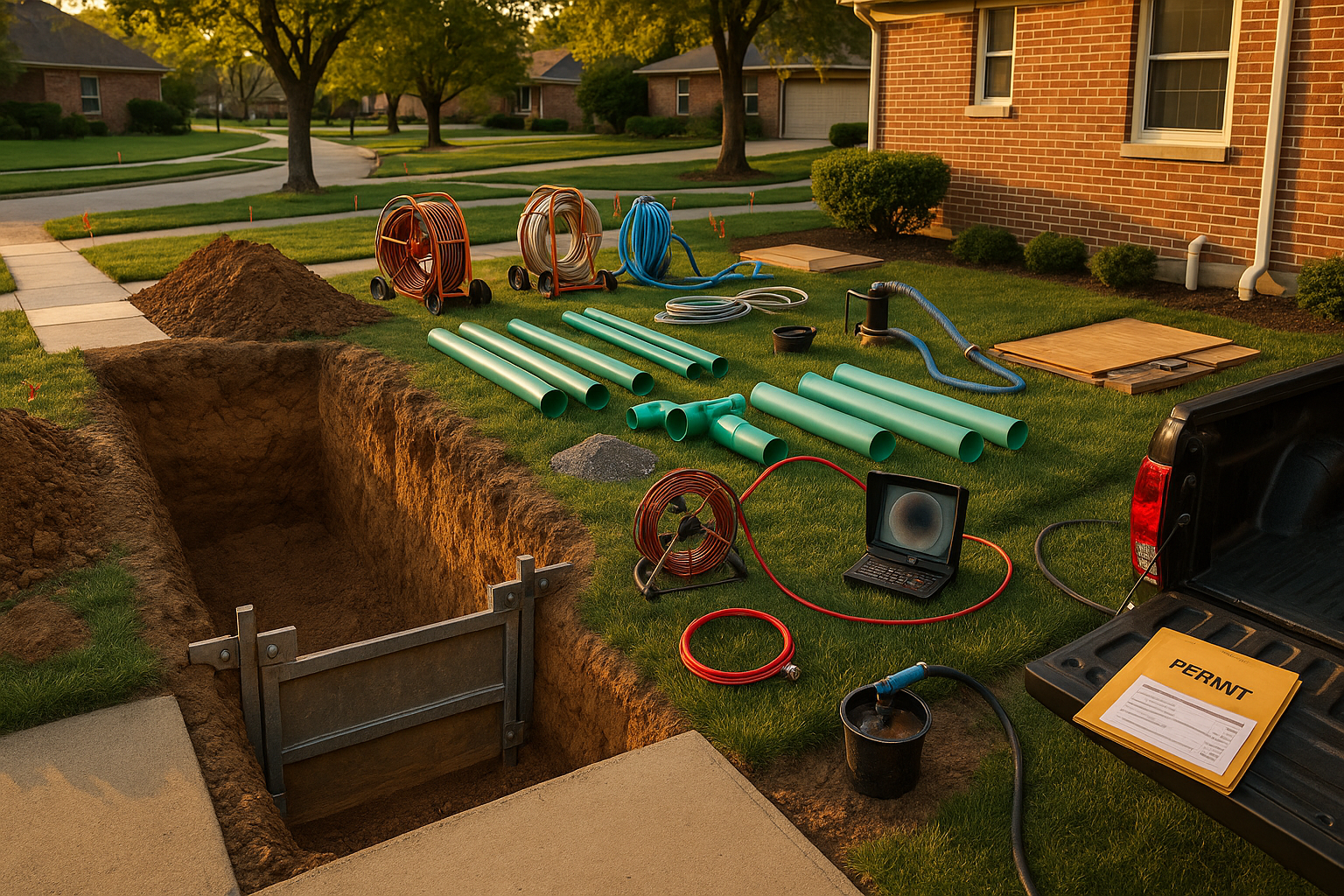
If you’re seeing repeat backups, slow drains, or soggy patches in the yard, you’re right to ask what sewer line replacement will really cost in Indianapolis. WaterPros is a local specialist—our planning‑first process uses sewer camera inspection, clear scopes, and premium materials so you know exactly what you’re paying for before work begins.
Typical sewer line replacement cost in Indianapolis
For most single‑family homes with a 30–60 ft lateral, expect these local ballparks:
- Total replacement (open‑trench): $4,500–$18,000+ depending on depth, access, and restoration
- Trenchless lining or pipe‑bursting: $6,500–$22,000 when access pits are feasible and pipe condition allows
- Cost per foot sewer line Indianapolis (typical):
- Open‑trench: $80–$200/ft
- Trenchless: $120–$300/ft (covers specialized equipment and lining materials)
These ranges reflect common conditions in Marion County—clay‑heavy soils, typical depths of 6–10 ft, and restoration requirements near sidewalks or driveways. Your exact price is driven more by depth, access, and surface restoration than by the pipe itself.
What drives the price (and where the money goes)
Line length, depth, and access
- Length: A 30 ft run costs materially less than a 70 ft run—linear footage is a core driver.
- Depth: Deeper lines require shoring, larger equipment, and additional labor. Indy laterals commonly sit 6–10 ft deep; bellies or main tie‑ins can be deeper.
- Access: Narrow side yards, fences, mature trees, or alley approaches influence method and equipment selection.
Method and materials
- Open‑trench replacement: Often most economical when lawn is being redone or surfaces are already scheduled for replacement.
- Trenchless sewer line cost Indianapolis: Lining (CIPP) or pipe‑bursting carries higher per‑foot costs but can drastically reduce surface restoration and shorten timelines.
- Pipe spec: Replacement laterals commonly use SDR‑35/PVC or HDPE. Lining uses resin‑impregnated felt or fiberglass tubes cured in place (CIPP) where pipe condition allows.
Restoration scope
- Lawn and sod: roughly $1–$3/sq ft
- Concrete: roughly $8–$15/sq ft (sawcut, pour, finish)
- Asphalt: roughly $6–$12/sq ft
- Pavers/landscaping: variable—historic brick and complex beds add time and care Trenchless significantly reduces these line items when feasible.
Permits, inspections, and coordination
- Permit cost sewer Indianapolis (typical): $150–$500 for plumbing and any right‑of‑way (ROW) or traffic control needs.
- Citizens Energy sewer lateral: Homeowners are typically responsible from the house to the main; coordination may be required if work enters the ROW or impacts the main connection.
- 811 locates are mandatory; expect colored flags/paint ahead of excavation.
Soil, groundwater, and weather
- Indianapolis clay holds water; perched groundwater near White River/Eagle Creek can require dewatering.
- Freeze‑thaw cycles and heavy spoil management affect production rates and disposal fees.
Trenchless vs. open‑trench under Indy conditions
- Trenchless (CIPP lining or pipe‑bursting):
- Pros: Minimal disturbance to lawns, roots, sidewalks, and driveways; fast completion (often one working day once pits are prepped); strong manufacturer support when conditions are suitable.
- Cons: Higher per‑foot costs; requires usable host pipe for CIPP; access pits still needed; not ideal for severe bellies or fully collapsed segments.
- CIPP lining cost Indianapolis varies with diameter, access, and reinstatements; it’s common for tight urban lots in Broad Ripple, Meridian‑Kessler, Irvington, and Speedway where surfaces are valuable.
- Open‑trench:
- Pros: Often most cost‑effective when surfaces are already being replaced; allows correction of grade/bellies and full visual inspection; no reliance on host pipe.
- Cons: More surface restoration; slightly longer site disruption.
If your line passes under a sidewalk, mature tree, or newly poured driveway, trenchless can save thousands in restoration. Where Orangeburg has collapsed or severe bellies exist, open‑trench or pipe‑bursting usually wins for long‑term reliability.
Repair or replace? Making the call with evidence
- Choose spot repair when: A single, well‑defined defect exists (e.g., one offset joint), grade is correct, and the remaining pipe walls are sound.
- Choose full replacement when: Multiple failures appear along the run; heavy root intrusion returns quickly; the line is deteriorated clay or Orangeburg; or camera shows severe bellies/collapse.
A sewer camera inspection Indianapolis report should guide the decision. Hydro‑jetting is often used first to clear roots and allow a truthful inspection of the host pipe.
What a clear, fixed‑scope quote should include
Expect a professional, line‑item scope—not a vague lump sum. WaterPros provides: - Video findings with clear footage and stills - Exact linear footage and measured depths - Method: open‑trench, CIPP lining, or pipe‑bursting with rationale - Pipe specification (e.g., SDR‑35/PVC), bedding, and backfill plan - Cleanout placement (near the foundation for future maintenance) - Surface restoration scope and materials by area (lawn, concrete, pavers) - Permits, inspections, and any ROW/traffic control coordination - Groundwater/dewatering allowances if relevant - Timeline with daily work plan and homeowner access needs - Warranty terms disclosed up front (lining products often carry 10–25 year manufacturer support when conditions are suitable) - Total price, allowances, and what could change—so surprises are unlikely
Typical add‑ons and allowances
- Sewer camera inspection: $150–$350 (often credited if work proceeds)
- Hydro‑jetting to prep the line: $250–$600
- Sewer cleanout installation cost: $400–$1,200 depending on depth and surface
- Bypass pumping (if flows must be maintained): varies by setup
- Post‑repair verification video: included or modest fee, depending on scope
Permits, timeline, and expected disruption
- Permits/coordination: Plan for Indianapolis/Marion County plumbing permits; ROW permits and traffic control if work enters the sidewalk or street; Citizens Energy Group coordination near the main.
- Timeline: Most residential replacements take 1–3 working days; trenchless often completes in one day after access pits are opened and the pipe is prepped. Final restoration can follow after inspection.
- Service downtime: Expect several hours without sewer service during critical tie‑ins. WaterPros schedules these windows with you and can provide temporary solutions when needed.
- Winter work: Yes—winter sewer replacement is feasible in Indianapolis. Cold‑weather practices and ground‑thaw equipment may add time or modest cost, but it can be an ideal window when schedules are open and landscaping is dormant.
Ways to control cost without cutting corners
- Choose trenchless where surfaces are expensive to replace or access is limited.
- Complete work before major landscaping or hardscaping projects.
- Bundle cleanout installation with replacement for better long‑term maintenance.
- Insist on a fixed‑scope, line‑item quote and a video you can keep.
- Confirm property lines and ROW boundaries to avoid relocating a new cleanout later.
- Avoid repeated snaking on failing Orangeburg/clay—money spent on temporary clears often exceeds the cost of a permanent fix.
Local context: what we see across Indy neighborhoods
- Older areas like Broad Ripple, Meridian‑Kessler, Irvington, and Speedway often still have clay or Orangeburg laterals that invite roots and can collapse under load.
- Typical depths of 6–10 ft mean shoring and careful spoil management in clay soils.
- Historic districts and brick pavers demand extra protection and higher restoration budgets.
- Sidewalk or street crossings may require DPW permits and precise restoration details.
FAQs
How much does sewer line replacement cost in Indianapolis on average?
Most Indy homes land between $4,500 and $18,000+ for open‑trench, and $6,500 to $22,000 for trenchless, depending on length, depth, restoration, and method.
What is the cost per foot for replacement vs. trenchless lining?
Open‑trench commonly runs $80–$200/ft. Trenchless (CIPP or bursting) often runs $120–$300/ft. The difference is frequently offset by lower restoration costs.
How do I know if I need full replacement or just a spot repair?
A camera inspection and grade assessment decide it. Isolated defects can be spot‑repaired; widespread root intrusion, bellies, or collapsed Orangeburg usually call for full replacement.
How long does the process take from permits to restoration?
Permitting is typically quick; most installs take 1–3 working days. Trenchless often finishes in a single day; surface restoration may follow after inspections.
Do you handle Indianapolis/Marion County permits and Citizens Energy coordination?
Yes—professional contractors should secure required permits, schedule inspections, and coordinate with Citizens Energy Group when the work approaches the main or ROW.
Will trenchless work with clay or Orangeburg pipe?
CIPP needs a reasonably intact host pipe; severely deteriorated Orangeburg may be poor for lining, making pipe‑bursting or open‑trench preferable. Clay commonly lines well after cleaning if structurally sound.
What are typical restoration costs?
Expect $1–$3/sq ft for lawn/sod, $8–$15/sq ft for concrete, and $6–$12/sq ft for asphalt; pavers and landscaping vary widely.
Is winter sewer replacement possible in Indianapolis and does it cost more?
It’s feasible with cold‑weather methods. Costs can be similar; schedule and restoration timing may change slightly.
Does homeowners insurance cover sewer line replacement?
Policies rarely cover wear‑and‑tear. Check for sewer lateral add‑ons or endorsements. Keep camera reports and documentation for any claim or financing discussion.
Do you provide video of the sewer inspection and a written scope?
You should receive both. WaterPros documents findings with video, stills, and a line‑item scope so decisions are clear.
Where should a cleanout be installed and is it required?
Near the foundation at an accessible location is ideal for maintenance and often required by code on major repairs.
What warranties are available for trenchless lining vs. open‑trench replacement?
Manufacturer warranties for lining often range 10–25 years when conditions are suitable. Workmanship/material terms for open‑trench PVC/HDPE are disclosed in your written scope.
Who is responsible for the sewer lateral in Indianapolis?
Homeowners are generally responsible from the home to the main; Citizens Energy manages the public sewer. ROW work may require additional permits.
Can financing or payment plans reduce upfront cost?
Many homeowners use financing or utility‑approved programs to spread costs. Ask us to discuss current options in your quote review.
What signs mean my sewer line is failing?
Recurring backups, slow drains after rain, sewer odors, foundation cleanout overflow, and persistent wet/sunken yard areas are common flags.
Your next step: a local camera inspection and fixed‑scope quote
Start with evidence. We’ll perform a camera inspection, review footage with you on‑site, and present a clear, line‑item plan—open‑trench or trenchless—with restoration spelled out. See typical methods and timelines on our Indianapolis service page: /sewer-line-replacement-indianapolis/. When you’re ready, request scheduling here: /#quote.
Prefer to read more first? Visit our /blog/ for practical guides on trenchless vs. open‑trench, restoration planning, and common Indy pipe materials.
Have questions about scope, permits, or keeping disruption low? Get a Free Deck Consultation. WaterPros keeps communication clean, the scope precise, and the materials correct for Indianapolis soils and seasons—so the result is reliable and the process is predictable.
Need a plumber you can call back?
Licensed Indiana plumbers, flat-rate pricing, and a written warranty on every job.