My neighbor Tim in Fishers called me last spring, voice cracking a little. He and his wife were expecting their first kid, and they’d just gotten their well test back—nitrates at 12 mg/L. “Is that bad? The water looks fine, tastes fine. But what about the baby?” He’d read something about blue baby syndrome online and was freaked out. I hear that worry a lot. If you’re on a well anywhere around Indianapolis—from the rolling edges of Carmel to the suburban-farm mix in Greenwood—nitrates in well water are one of those invisible headaches nobody talks about until it’s personal.
How nitrates get into your water
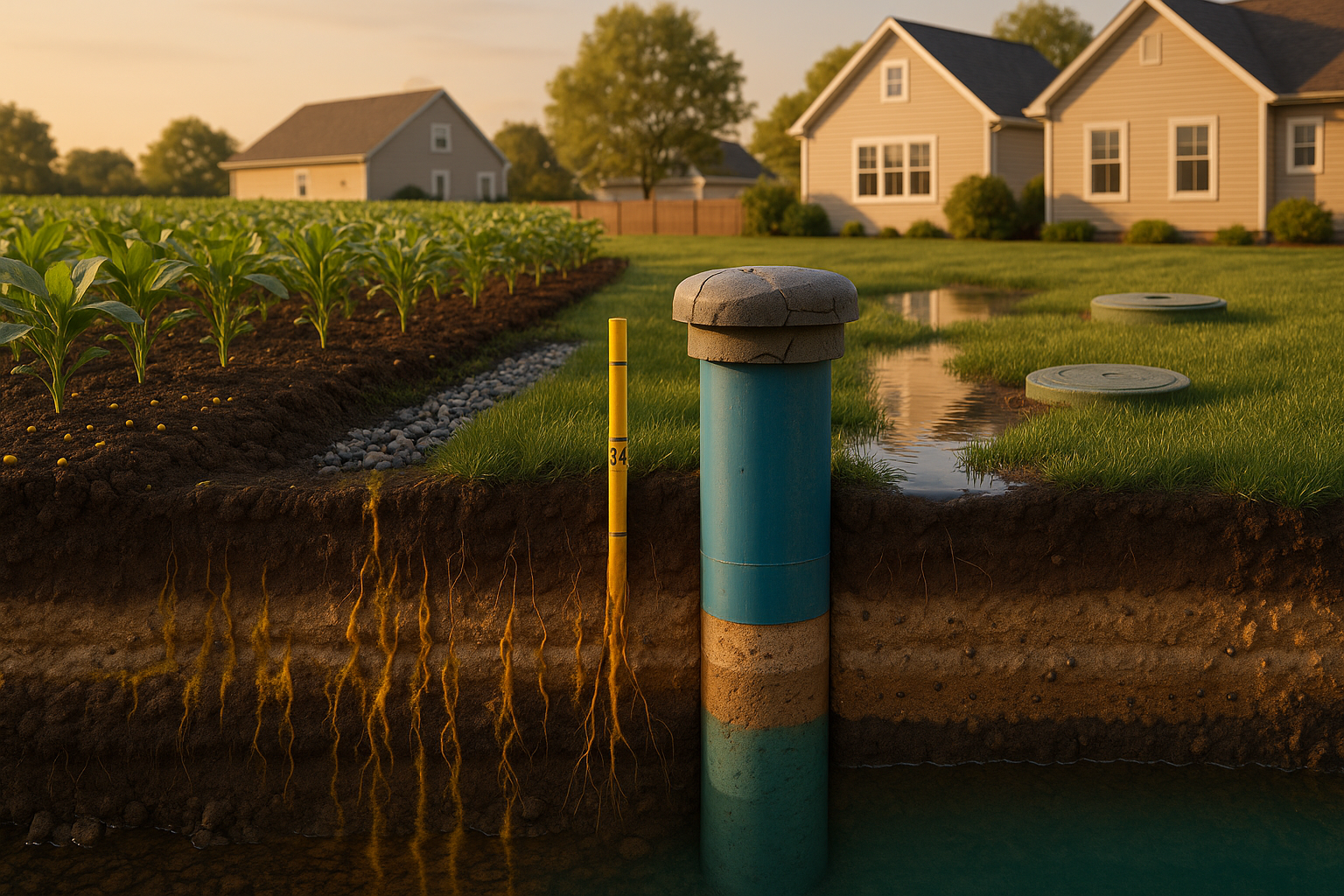
Nitrates are a form of nitrogen, and they come from fertilizer, manure, and waste. Around here, it’s mostly agricultural runoff. That big soybean field down the road? After a spring rain, nitrate can wash into the soil and eventually down into your aquifer. But it’s not just farms. Homeowners with septic systems sometimes don’t realize a slow leak can be a steady nitrate source, especially in older systems in neighborhoods like Zionsville or Westfield where houses are spread out. We’ve seen septic-related nitrate contamination in areas where the soil doesn’t filter well, and that’s where good septic system service matters—a spotty drainfield can turn into a groundwater problem you can’t smell.
Also, the condition of your well itself matters. A poorly sealed well cap or a casing that’s cracked can let surface water in, carrying nitrates right past the natural filtering. A well drilling contractor can check the construction and tell you if it’s time for a repair or upgrade. I’ve seen shallow wells (like 30-50 feet) that test fine most of the year but spike in April after heavy rain and fertilizer applications. If your well’s older and you’re out in Plainfield or Brownsburg, it’s worth an inspection.
Why you should care
I’ve heard folks say, “My water looks crystal clear, so it must be good.” Nitrates are colorless, odorless, and tasteless. You can’t see or taste them until it’s too late. The big health risk is methemoglobinemia, or “blue baby syndrome,” which reduces the blood’s ability to carry oxygen. Infants under six months are most at risk because their stomach acid converts nitrate to nitrite, which messes with hemoglobin. Pregnant women and people with certain immune issues should be cautious too. The EPA sets the maximum contaminant level at 10 mg/L (as nitrogen), and I tell every client with babies or a pregnancy in the house to treat anything above that as a hard stop—don’t use it for formula or drinking.
There’s a myth that boiling water fixes it. Nope—boiling just evaporates some water, making the nitrate concentration higher. Another one: a carbon pitcher filter like Brita won’t touch nitrates. And if you have a water softener, that’s great for hardness but it doesn’t remove nitrates. (We install a ton of softeners for that awful central Indiana hard water—check out our softener salt vs. potassium article for the right setup—but don’t count on it for nitrate.) UV lights and chlorine? They kill bacteria but don’t change nitrate chemistry. We’ve written about UV purification for wells before—it’s perfect for coliform, useless for nitrate.
Testing: do it right
Testing isn’t complicated, but you want a certified lab, not a cheap dip strip. Grab a sample kit from a local health department or a place like WaterPros. Collect the water before any treatment equipment, from a cold tap after running it a few minutes. I tell folks to test annually, but if we’ve had a wet spring or big snowmelt, test again. Nitrate levels can jump in shallow wells after a heavy storm because that’s when fertilizer really moves. In Hamilton County, where new subdivisions are mixing with farm fields, I’ve seen nitrate bounce around 8-10 mg/L depending on the season.
After testing, if you get a number like 11 or 12, don’t panic. You can switch to bottled water or an RO system for drinking and cooking while you figure out a permanent fix.
What actually works
There are three proven ways to knock nitrates out of your water:
- Reverse osmosis (RO): This is the go-to for most families. An under-sink unit pushes water through a membrane that stops nitrates and a lot else. It’s point-of-use, meaning it handles a single tap—usually at the kitchen sink. RO does waste about 3-5 gallons for every gallon produced, but if you’re just running a dedicated faucet for drinking and cooking, it’s manageable. We install these in Avon, Carmel, you name it. Maintenance is swapping filters once or twice a year and the membrane every few years.
- Anion exchange: This is a whole-house system, kind of like a water softener but for nitrates. It swaps nitrate ions for chloride. It works great if you have other water-quality bugs like high iron or manganese—though for iron, you might need a pretreatment filter. Our article on iron and sulfur treatment explains why prefiltration matters. Anion systems are bigger investments, but you protect every tap. They do need a salt tank and regular regeneration, just like softeners.
- Distillation: It’s rare, but it works. You boil water and collect the steam, leaving nitrates behind. It’s slow and consumes energy, but for a small household or office breakroom, it’s an option.
Before you buy anything, have someone look at your whole water. If you’ve got high iron or hard water, that affects which nitrate system will work best. The same goes for drainage around your well. Good drainage service—like grading or a French drain—keeps surface water from pooling near the wellhead and pushing nitrate-laden runoff down the casing. It’s a small detail that can make a big difference.
Point-of-use vs. whole-house
For most homes, a point-of-use RO under the kitchen sink is the sweet spot. You protect where you drink and cook without treating irrigation or toilets. But if you have a newborn and you’re mixing formula, or if your spouse is pregnant, you might sleep better with whole-house. Some clients in Noblesville with high nitrates start with an RO and add an anion system later. Either way, you do you—but test first and design the system around your family’s habits.
Keep it running
Whatever system you pick, you’ve got to maintain it. RO membranes don’t last forever, and anion resin can foul if you ignore hardness or iron. Set a reminder to replace cartridges, and retest your water at least once a year to verify the system is still working. We always do a follow-up test a few weeks after install to confirm the numbers, and then recommend spring and fall as good times for rechecks. In Indiana, spring nitrate spikes are real, so don’t assume a good test in August means you’re safe the next April.
What’s next
If any of this sounds familiar—maybe you’ve got a baby on the way, or you’re just tired of wondering every time you pour a glass—the first step is a solid water test. At WaterPros, we don’t push gear until we know your numbers and your home. We’ll check your well cap, your plumbing, and your water chemistry, then walk through options that make sense for your budget and your life. It’s not a sales pitch; it’s just good sense. Ready to stop worrying? Schedule a water test and consultation, and let’s sort it out. If you’ve got specific questions, our blog has a ton of down-to-earth advice, or you can get a quote once we’ve tested.
Need a plumber you can call back?
Licensed Indiana plumbers, flat-rate pricing, and a written warranty on every job.