My neighbor Jim had a sewer backup last spring that flooded his basement with an inch of muck. He panicked, picturing a backhoe tearing through the rose garden his late wife planted. Turns out, he didn’t need to dig any of it up. A crew came out, made two small access pits, and fixed the pipe from the inside—trenchless sewer repair. That’s really what we’re talking about here: a way to save your yard and your sanity when your sewer line goes bad.
Carmel has a lot of older homes with clay tile or cast iron sewer lines. These materials crack, shift, and let tree roots sneak in. If you’ve got slow drains, gurgling toilets, or that rotten-egg smell in the basement, it’s often a busted lateral. Traditional repair means a long trench, ripped-up driveways, and weeks of dust and noise. But trenchless sewer repair in Carmel, Indiana gives you a smarter option—minimally invasive and usually done in a day.
What Exactly Is Trenchless Sewer Repair?
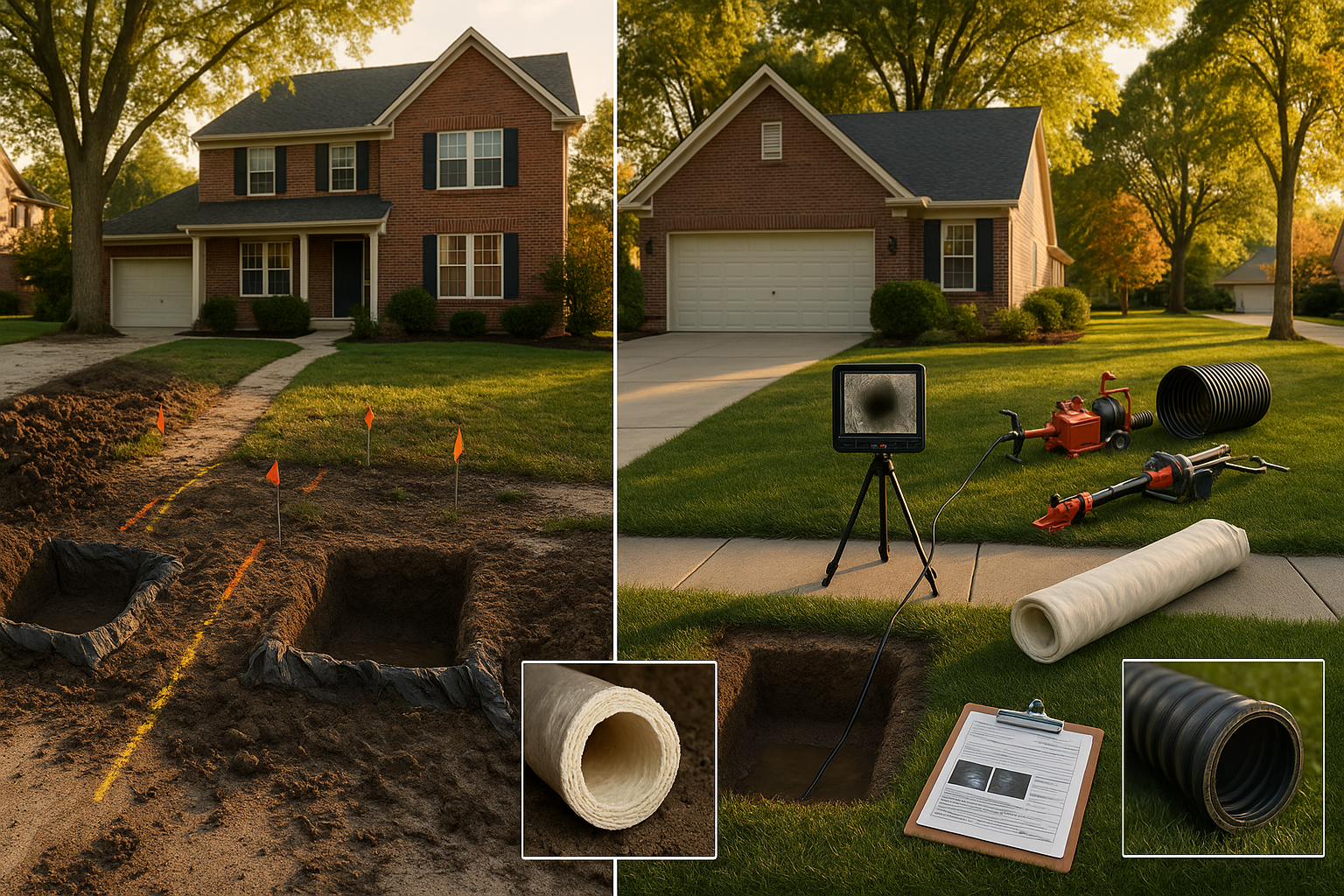
Think of it like keyhole surgery for your yard. Instead of digging a trench from your house to the street, we use your existing pipe as a guide. There are two main methods: CIPP lining and pipe bursting. With lining, we soak a felt tube in epoxy, pull it through the damaged pipe, inflate it, and let it cure. You end up with a brand new pipe inside the old one—smooth, seamless, and sealed against roots. Pipe bursting is for pipes that are too far gone: collapsed, undersized, or with sags. A bursting head pulls through the old pipe, fracturing it outward while a new HDPE pipe slides in right behind it. Both ways mean we only need small pits at either end. Your grass stays green, your driveway stays intact.
When Does Trenchless Make Sense in Carmel?
Our heavy clay soil in Hamilton County shrinks and swells with freeze–thaw cycles, putting stress on old joints. Add mature trees—all those oaks and maples in neighborhoods like Brookshire or Woodfield—and root intrusion is a constant battle. If your sewer runs under a concrete patio, a sidewalk, or a prized magnolia tree, traditional digging could cost a fortune in restoration. That’s where a no-dig approach really shines. WaterPros starts every job with a camera inspection. We send a waterproof camera down your line and record everything—cracks, root balls, offsets, you name it. You’ll see what we see, and we’ll walk you through the options before any dirt is moved.
The Carmel Conditions We Plan For
Before we even think about repair, we handle Indiana 811 utility locates. Lines for gas, electric, water—all marked out so we don’t hit anything. Permits? We handle those too, whether it’s city paperwork or HOA requirements. Carmel has a lot of subdivisions with strict landscaping rules, and we know how to keep the job tidy. We also check for nearby drainage lines, sump pump discharges, or irrigation systems that could interfere. After the work, we do a post-repair camera run and hand you the video—proof that your line is right.
Speaking of drainage, it’s not uncommon to find that a slow-draining basement or a soggy yard isn’t just a sewer issue—your perimeter drains or downspouts might be tied in wrong. Our drainage service guys can sort out yard drainage problems so water actually flows away from your foundation. That’s separate from the sewer lateral, but it’s all connected in keeping your home dry.
Lining vs. Bursting: Which One Do You Need?
If your pipe is mostly intact but has cracks, leaking joints, or root intrusions, CIPP lining usually does the trick. It’s cost-effective and adds structural strength. But if the pipe has collapsed sections, severe sags (bellies), or it’s undersized for your household, we lean toward pipe bursting. Bursting also works great for Orangeburg—that fiber-conduit stuff from the 1950s that falls apart if you look at it wrong. Either way, you’re getting a solution that’s code-compliant and built to last 50 years or more.
Will It Really Save My Yard? And Other Objections
Every homeowner asks the same thing: “Is my lawn going to look like a war zone?” No. We dig two small pits—usually about 4 by 4 feet—where the pipe starts and ends. We lay down tarps, keep soil contained, and restore those spots with topsoil and seed when we’re done. A couple weeks later, you can’t even tell.
“But isn’t trenchless more expensive?” It can be, depending on the job, but when you factor in the cost of ripping out and replacing a driveway, sidewalk, or landscaping, it often ends up cheaper—and definitely less headache. We give you a written, itemized quote upfront based on the camera findings, so there are no surprises.
“How long will I be without plumbing?” Most repairs finish in a day. We might ask you not to use the water for a few hours while the liner cures, but we’ll give you a clear timeline.
And if you’ve got a septic system, the same trenchless methods work from the house to the tank, or from the tank to the drain field. We do septic system service across Hamilton County, and we’ve saved plenty of rural homeowners from having to tear up their pastures or tree lines.
Water quality plays a role too. If you’re on well water, hard water can leave scale in your pipes over time, narrowing them and making backups worse. We’re also a water softening equipment supplier and a well drilling contractor, so we can help you fix the water coming into your home while we fix the water going out.
What Happens During a Trenchless Repair
You call us, we schedule a camera inspection—that’s the biggest step. It takes about an hour. We’ll give you a condition report and a fixed scope of work. Once you approve, we book a date. On the day, we show up, set up, and get moving. The pits are dug carefully by hand if needed, and we use electronic locating to pinpoint the pipe’s path. For lining, we prep the pipe with hydro jetting if there’s buildup, then pull in the liner and let it steam-cure. For bursting, we rig the pulling machine and swap in the new pipe. We’ll do a final camera pass, show you the footage, and backfill those pits neatly.
If mid-project we find something unexpected—like a fully collapsed section we can’t pass—we’ll talk to you about it on the spot. Sometimes a small spot repair is needed before lining, or we switch to bursting. We explain everything plainly, no technical jargon.
Getting Started—What You Can Do Today
You don’t need to know the exact problem. That’s what a camera inspection tells you. If you’re in Carmel, Fishers, Zionsville, or anywhere around, and you’re seeing signs of sewer trouble, call us or book online. We’ll come out, film your line, and lay out your options. You can even ask for a trenchless repair quote right here.
While you’re at it, check out our blog for more plumbing tips or see why your neighbors choose us for plumbing in Carmel. We’re local, we talk straight, and we’d rather save your yard than tear it up.
Need a plumber you can call back?
Licensed Indiana plumbers, flat-rate pricing, and a written warranty on every job.