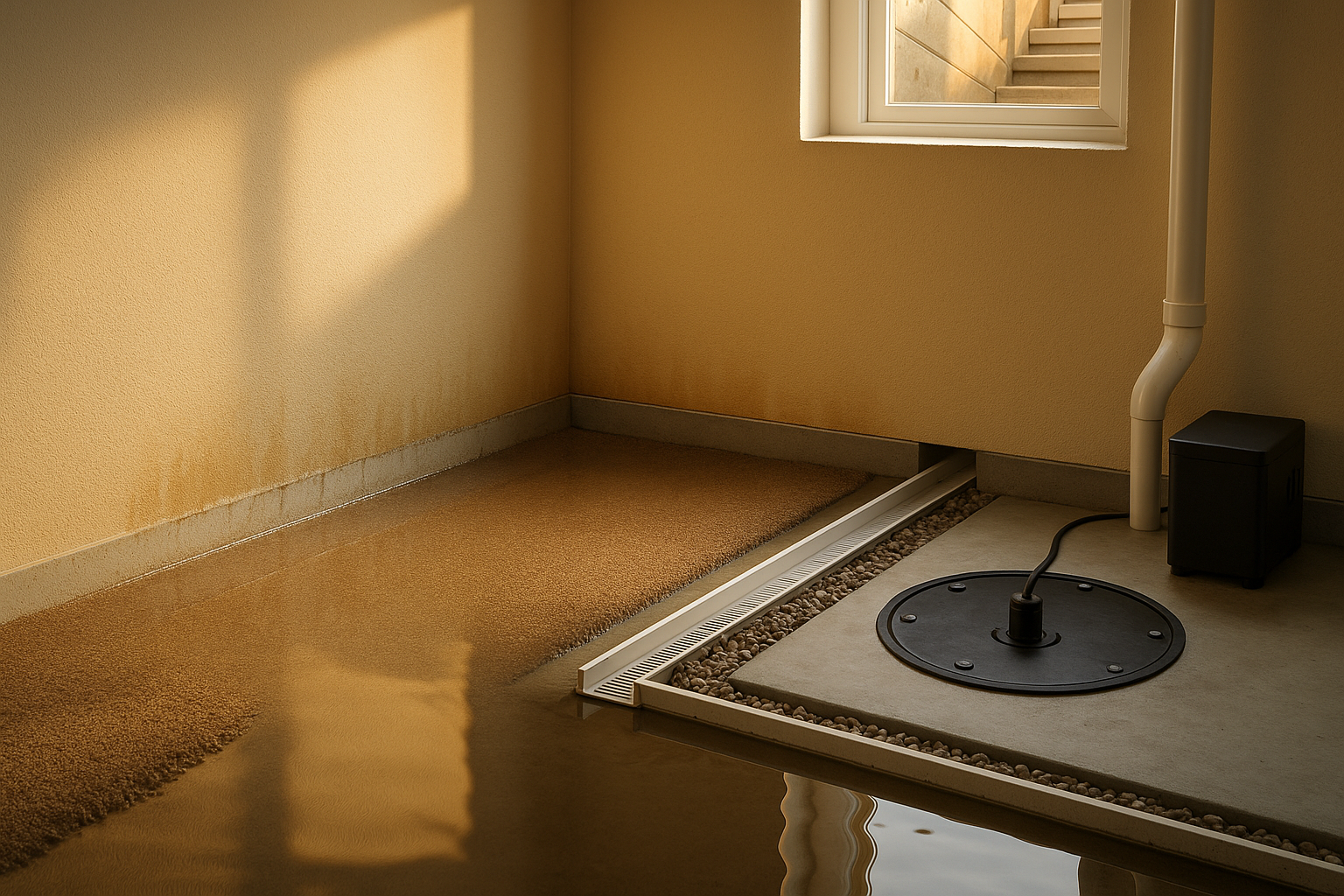
Last March, my friend Jen called me in a panic. She’d just come home to find her finished basement in Fishers had about an inch of standing water. Not from a broken pipe—just from the relentless spring rain. She’d spent thousands finishing that basement, and now the carpet was ruined and drywall was wicking moisture. That’s when she asked me, ‘Do I need a French drain or a sump pump?’ Honestly, it’s the question I hear most from homeowners around Indianapolis, Carmel, Zionsville, you name it. And it’s rarely a one-or-the-other answer. Let’s break it down without the sales pitch, just what I’ve learned from seeing too many wet basements and soggy yards.
What’s the Difference, Really?
A French drain is basically a trench filled with gravel and a perforated pipe that collects water and moves it away from your house. It works by gravity—water seeps in, flows down a slight slope, and exits somewhere downhill or into a dry well. Think of it like a lazy river for groundwater and surface runoff. A sump pump, on the other hand, is an active system. You dig a pit in the lowest spot of your basement or crawl space, and when water accumulates, a pump kicks on and pushes it out through a discharge pipe. It’s the muscle that fights water that’s already found its way under your foundation.
The real difference? French drains tackle water before it gets to your foundation (or collect it from your yard), and sump pumps deal with water that’s already pushing up from under the slab. So it’s not about which one is better—it’s about what problem you’re actually facing.
When French Drains Shine
If you’ve got water pooling in your yard after a heavy rain, or a downspout dumping right next to the house, a French drain might be your hero. I remember walking a property in Brownsburg where the back corner of the lot never dried out. Their gutters were clean, but the grade funneled runoff right at the foundation. We installed a French drain running from that low spot out to a pop-up emitter at the curb. Problem solved. The house stayed dry without a pump ever running.
Exterior French drains also act as a first line of defense for your basement—a foundation perimeter drain. Installed around the exterior, they intercept water seeping toward your foundation walls. That said, in central Indiana, our heavy clay soil drains so slowly that exterior drains alone often can’t keep up with the hydrostatic pressure that builds during a week-long storm. You might still need a pump to handle what sneaks through.
Another spot French drains excel: crawl spaces. If you have standing water under your house, an interior French drain channel (sometimes called drain tile) can route that water to a sump pit. But here we’re already blurring the lines—a French drain feeding a sump pump is a classic combo.
Just like any drainage system, French drains can get clogged over time, especially in our heavy clay. A professional cleaning might be in order—check out typical drain cleaning costs in Indianapolis if you suspect a clog.
When Sump Pumps Save the Day
Sump pumps are the real savior for finished basements. If you walk downstairs and your walls feel damp or you see water seeping at the cove joint where floor meets wall, that’s hydrostatic pressure. No exterior French drain alone will stop that. You need to relieve that pressure from inside. That’s where interior drain tile comes in—a channel cut around the basement perimeter, tied to a sump pit, with a pump to eject the water.
I’ve seen this in older neighborhoods like Meridian-Kessler in Indianapolis, where stone foundations act like sieves after a thaw. A sump pump gives you peace of mind, especially with a battery backup. Because around here, when storms knock out power, sump pumps stop, and basements flood. That’s why we always recommend a backup. If you’re on a well, a flooded basement can introduce surface contaminants into your water supply, so a reliable sump pump is even more critical. And if you’re worried about the noise, modern pumps with rubber isolators are whisper-quiet. Plus, a sealed lid keeps out radon and smells. No ugly pit—just a clean flush cover.
One seasonal headache: in Indiana, sump pump discharge lines can freeze solid in winter. A little planning with insulated pipe, an air gap, and a slope can keep it flowing. We’ve got a whole post on that: sump pump discharge line freezing in Indiana.
Why Not Both? The Combo Approach
For a lot of Indianapolis-area homes, the smart money is on using both. Interior drain tile to a sump pump handles the groundwater, while a targeted exterior French drain catches yard runoff and downspout water before it ever reaches the foundation. Combine that with extended downspouts and proper grading, and you’ve got a defense-in-depth strategy.
Here’s a thought: if you’ve got a water softener discharging brine outside, make sure it’s not pooling near the foundation. That can mess with soil moisture and even create a slick, wet patch that mimics a drainage problem. And if you’re on a septic system, be extra careful about where all this water goes—saturated drain fields are a recipe for backups. A drainage plan should consider your whole property’s water picture.
Now, cost-wise, it varies. A simple French drain might run a few hundred bucks for a DIY-grade trench, but a professional install with proper materials and grade is more. A sump pump system starts around a couple thousand for a basic interior drain tile and pump, but the real cost is in the concrete work and the discharge routing. Both are investments that pay back when you’re not scraping mold off drywall.
Making the Call for Your Home
So, how do you decide? Walk your yard after a rain. See where water stands. Check your gutters—are they overflowing? Downspouts draining right at the foundation? If the water’s coming from outside, fix those first. If your basement is damp or wet without any surface water issues, you’re probably dealing with groundwater, and a sump pump is the answer. Often, it’s both.
The flat lots around Fishers and Westfield can be tricky because you can’t always daylight a French drain by gravity alone. You might need a pump to push water up to the street. And in Zionsville, with its rolling hills, a French drain can work wonders if you’ve got slope. Every house is different.
And once it’s in, maintenance is simple: test your pump twice a year, clear debris from the pit, and check that discharge line isn’t blocked. A little attention goes a long way toward keeping your basement dry for the long haul.
If you’re tired of the stress when the radar turns green, give us a shout. We’ll do a no-pressure assessment, map out where the water’s coming from, check your elevations, and write up a clear plan. No jargon, no pushy upsells. Just a straightforward quote you can sleep on. Request a quote here.
Need a plumber you can call back?
Licensed Indiana plumbers, flat-rate pricing, and a written warranty on every job.