My buddy Jeff lives in Avon, out in a newer subdivision that’s not on city sewer. Last spring, he calls me up, kinda panicked. “I’ve got water pooling near the back deck and the shower drains like molasses,” he says. I tell him, “Jeff, when’s the last time you pumped the septic?” Silence. Then: “Uh… didn’t know I had to.” Classic. He’d been in that house for six years and never once thought about what was happening underground. A couple days later, after we got a pump truck out there, the driver shows me the scum layer—thick as a mattress, he said. Jeff’s drainfield was already soggy because the tank had been sending solids into the lines for months. He got lucky: a pump and a few months of reduced water use saved the field, but a lot of folks aren’t so fortunate.
If you’re in Brownsburg, Plainfield, or anywhere around Hendricks County, you probably rely on a septic system. And like Jeff, you might wonder: How often should I pump this thing? Let’s walk through it, straight from the folks who dig the holes.
So, how often should you really pump?
In Indiana, the rule of thumb is every 3 to 5 years. But that’s just a starting point. What really matters is your household. More people = more flushes, showers, and laundry. That means solids build up faster. A family of five might need pumping every 3 years, while a retired couple in a big tank could go 5 or even 6.
Tank size sets the baseline. Most homes around here have a 1,000- or 1,500-gallon tank. A larger tank holds more, so it can usually go longer between pumps. But if you’ve got an older, smaller tank—think 750 gallons—don’t push it past 3 years.
Then there’s your water habits. Do you have a teenager who takes marathon showers? Run the washing machine nonstop on weekends? Leaky toilets silently add gallons every day. All that water pushes solids through the tank before they can settle, which overloads the drainfield.
And for the love of plumbing, if you use a garbage disposal, treat that like a fast-forward button on your pump schedule. Grinding up food adds extra gunk that doesn’t break down well. It can easily cut a year off your interval.
Around here, much of the soil is clay and glacial till. It drains slow. So when a drainfield gets overloaded, it doesn’t recover quick—especially in spring when the ground is already saturated. That’s why we tell folks to stay proactive.
What happens if you wait too long?
Jeff’s story isn’t the worst. I know a guy in Zionsville who ignored a gurgling toilet for months. Turned out his tank was so full of solids that the baffles had corroded, and the drainfield was toast. He ended up spending nearly $10,000 for a new field. A $300 pump could’ve prevented the whole mess.
Common signs you’re overdue: - Gurgling drains, especially when the washing machine empties. - Sewage odors near the tank or in the yard. - Wet or spongy spots over the drainfield, even when it hasn’t rained. - All your drains are moving slow, not just one.
That last one trips people up. A single slow sink might be a hair clog. But if every fixture is sluggish and you’re on a septic system? That’s the tank waving a red flag. (We’ve got a whole breakdown on slow drains vs. septic issues if you want to dig deeper.)
But I use septic additives… isn’t that enough?
Nope. Those bacteria packets and enzyme bombs? They might nibble at some grease, but they don’t remove solids. Sludge stays at the bottom until a vacuum truck sucks it out. Relying on additives is like putting a band-aid on a gushing pipe. Plus, they can throw off the natural biology in the tank. The best maintenance is plain old pumping on schedule.
We just bought the house and have no records.
Happens all the time. Assume nothing. Get a baseline. We often do a camera inspection before pumping to see what shape the baffles and lines are in. That way we can tell if there’s any hidden damage that needs attention beyond a routine pump.
It’s winter—can you even pump now?
Yes, absolutely. The frost line around central Indiana is about 30–36 inches, but properly installed tank lids are usually above that. We’ll locate and expose lids before the ground freezes if you call ahead. Snow on the ground doesn’t stop us.
I’m worried about yard damage.
A good crew uses boards or heavy-duty mats to spread the weight of the truck. We’ll remove a small patch of sod to access the lids, but when we’re done, it’s put back neatly. By the next growing season, you won’t see a trace.
What else affects your septic’s health?
A lot of homes around here have hard water, so water softeners are common. The backwash from the softener goes right into the septic tank. That salty brine doesn’t kill the bacteria like some people think, but it adds a lot of extra water. If your softener recharges often, you’re sending a surge through the tank that can stir up solids. At WaterPros, we install and service water softeners, so we can help you set the right recharge schedule and even talk about salt-free options if your septic seems stressed.
If you’re on a well, you’re probably on a septic too. That means your water comes from deep underground and then ends up in a tank in the yard. We drill wells and maintain them, so we see the full circle—from well pump to drainfield. Keeping both systems in good shape just makes sense.
And after a pump, protecting the drainfield is priority one. Make sure downspouts, sump pump outlets, and driveway runoff aren’t dumping extra water onto the drainfield. WaterPros handles drainage solutions—grading, catch basins, pipe extensions—so your septic field doesn’t get swamped. A soggy drainfield can’t treat wastewater, and that’s bad news.
What to expect when you get it pumped
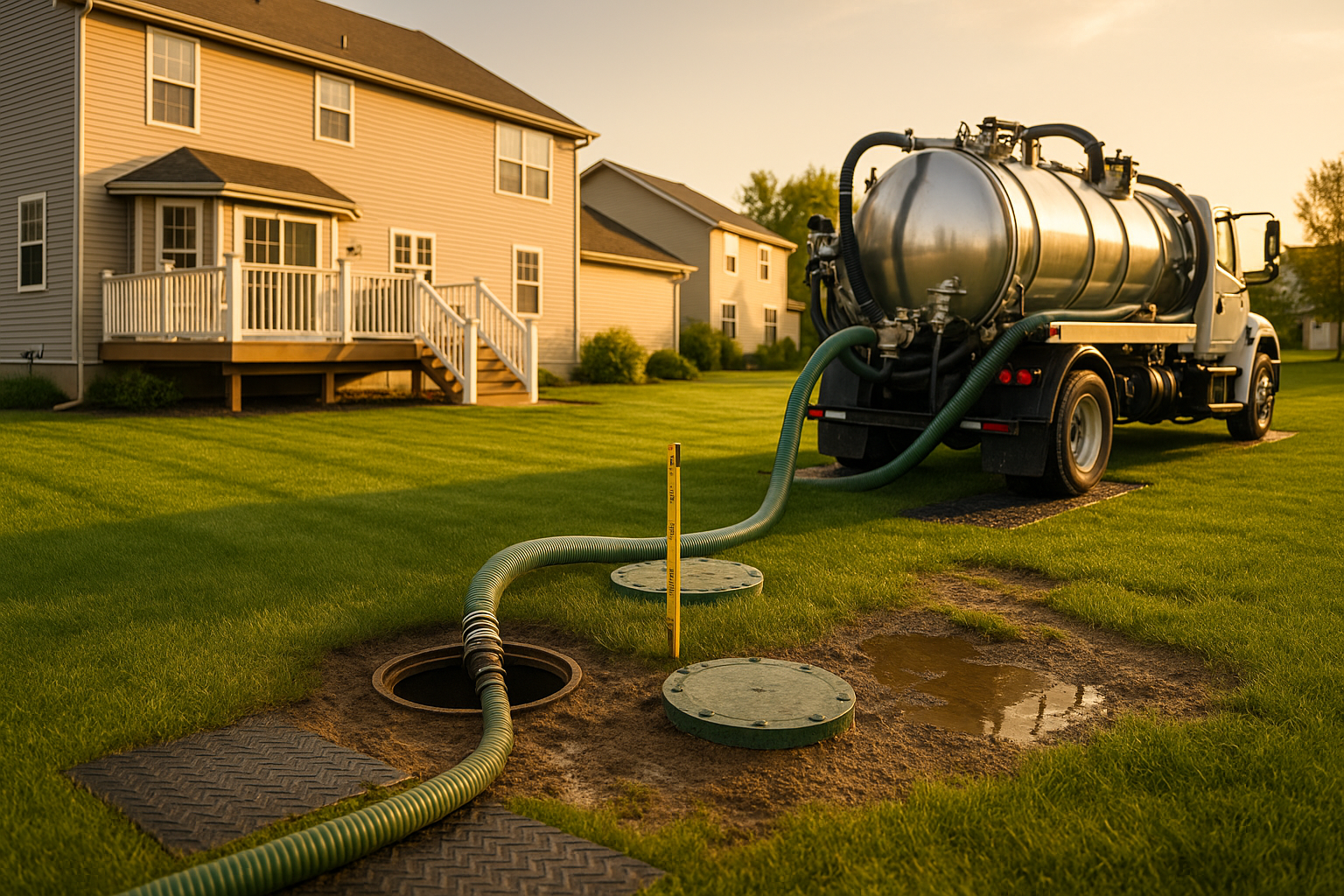
When we show up, we’ll locate the lids. Sometimes they’re buried under a few inches of turf—no big deal. We’ll measure the scum and sludge layers, then hook up the hose and pump everything out. We rinse the tank, check the baffles and tees, and hand you a quick report on how things looked. Whole thing usually takes under two hours. You don’t even need to be home if the lids are accessible.
Cost? Around here, a standard pumping runs a few hundred bucks depending on tank size and access. Compare that to a new drainfield at ten grand or more, and it’s the best money you’ll spend on your house this decade.
Ready to stop guessing?
If you’re in Brownsburg, Avon, Plainfield, Zionsville, or anywhere in the Indy metro and it’s been a minute since your last pump—or you’ve got a nagging feeling something’s off—give WaterPros a shout. We’ll give you a straight-up quote and get you on the schedule. No fluff, no scare tactics. Just a clean tank and peace of mind. Click here for a fast, no-pressure quote.
Need a plumber you can call back?
Licensed Indiana plumbers, flat-rate pricing, and a written warranty on every job.